
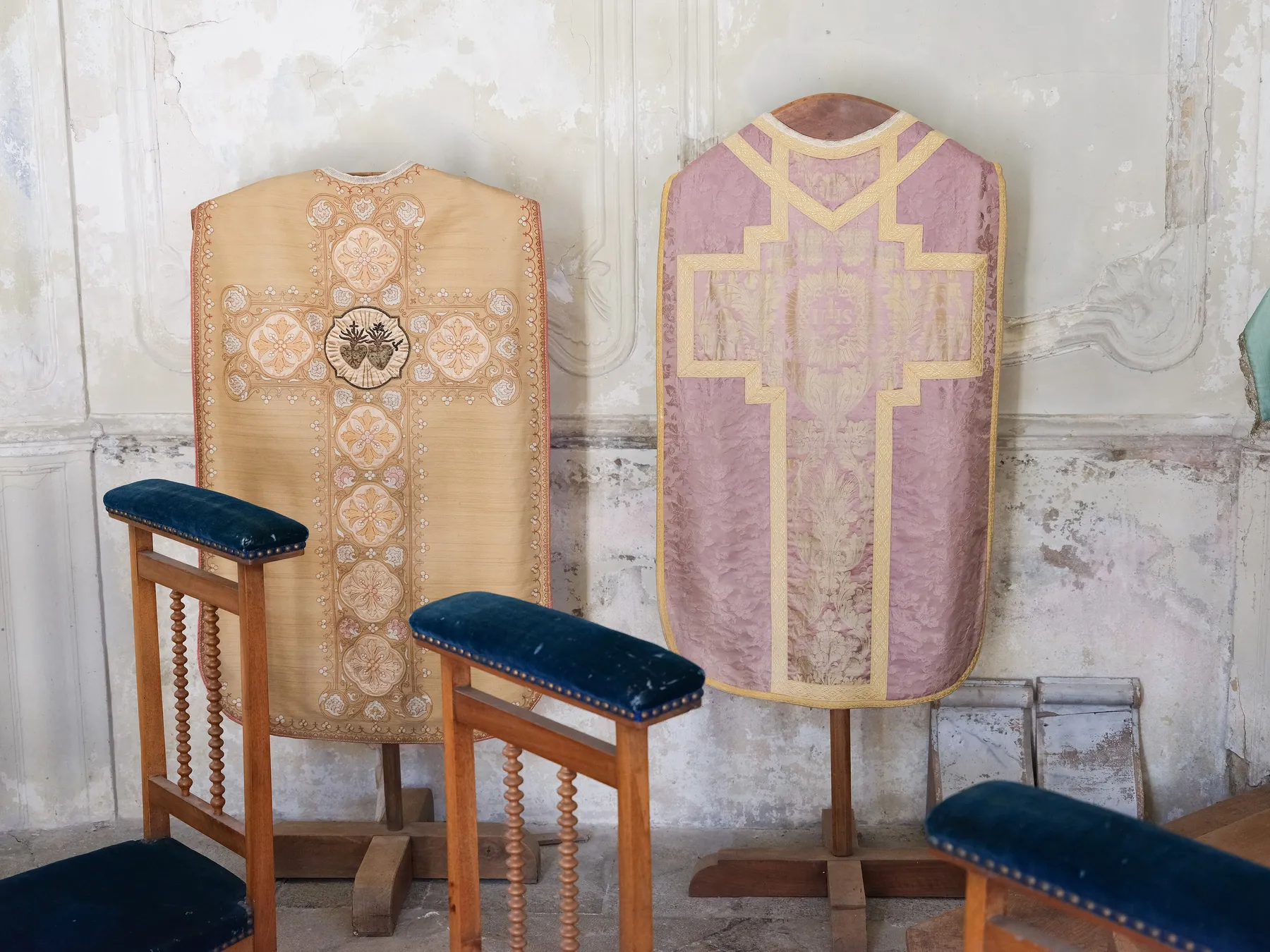
Vestments are bought rarely and worn for years, so the mistakes are expensive: an alb that drags, a chasuble in a fabric that pills, a stole in the wrong shade of violet. This guide covers what each garment is, how the liturgical colors run through the year, and how to measure before ordering.
The garments, from the inside out
| Garment | Who wears it | Notes |
|---|---|---|
| Alb | Priest, deacon, servers, lay ministers | White ankle-length tunic worn over street clothes or a cassock; the base of every other vestment |
| Cincture | Anyone wearing an alb | Rope belt; white for everyday, or in the liturgical color |
| Stole | Priest (around the neck), deacon (over the left shoulder) | The sign of ordained ministry; always in the color of the day |
| Chasuble | Priest at Mass | The outer poncho-like vestment, in the color of the day |
| Dalmatic | Deacon at Mass | Sleeved outer vestment, usually matched to the chasuble |
| Cassock and surplice | Clergy outside Mass, choirs, servers | Black (or red for servers) cassock with a white surplice over it |
| Cope | Priest or deacon at processions, Benediction, funerals | Long cape fastened at the chest |
| Clergy shirt | Priests and deacons in daily life | Tab collar or full Roman collar, in black or colors |
The colors through the year
- White (or gold): Christmas and Easter seasons, feasts of the Lord, Mary and non-martyr saints, weddings, funerals in many parishes.
- Red: Palm Sunday, Good Friday, Pentecost, feasts of martyrs and apostles, Confirmation.
- Green: Ordinary Time, the longest stretch of the year.
- Violet (purple): Advent and Lent, and penitential services. Advent violet is often a bluer shade; Lenten violet redder, but one set serves both.
- Rose: two Sundays only, Gaudete in Advent and Laetare in Lent. Optional, so many parishes borrow or skip it.
- Black: optional for funerals and All Souls. Blue is used for Marian feasts in some countries but is not a Roman Rite color in the United States.
A new parish or a priest starting out needs white, red, green and violet in both chasuble and stole. Rose and black can wait. Pulpit stoles for Protestant ministers follow the same calendar in most mainline churches, with the addition of a plain white or black stole for ordinary preaching.
Fabrics that last
Everyday chasubles are polyester or a polyester-wool blend, which drapes well, washes and holds color. Pure wool and silk damask look richer and cost several times more; they are dry-clean only and suit feast-day sets. A woven orphrey band or embroidered symbol wears better than a printed one.
Albs are the hardest-worn vestment. A washable polyester-cotton alb with a front wrap or zip and a square yoke is the practical choice for daily Mass. Linen albs breathe better in summer and look better, but need ironing. Hooded albs let the hood sit over a collar; square-yoke albs lie flat under a chasuble. For deacons who serve in warm churches, a lightweight blend is worth the search.
How to measure
- Alb length: measure from the base of the neck to the floor while wearing the shoes used at Mass, then subtract one inch. Makers size albs by that length in two-inch steps, with a chest measurement for the width.
- Cassock: same length as the alb, plus chest and sleeve length. Cassocks run narrow; order by chest, not by suit size.
- Chasuble: one size fits most; check the length from the shoulder, usually 50 to 54 inches, against the wearer's height so it clears the ankles.
- Clergy shirt: neck size and sleeve length like a dress shirt. Tab-collar shirts take a plastic tab; neckband shirts take a full detachable collar.
- Server albs and cassocks: sized by the child's height in inches; buy a size up for growth and hem.
Sizes differ between makers, so read the size chart on each listing rather than assuming a Medium matches the last one bought.
Servers and choirs
Altar servers wear either a white alb with a cincture, or a cassock in black or red with a white surplice. Albs are simpler to keep clean and need no surplice; cassocks look more traditional and show less wear. A rope cincture in white serves every day; cinctures in the liturgical colors are an inexpensive way to mark the seasons.
Choir robes are sold in sets of one color with a contrasting stole or yoke. Buy a range of lengths rather than one size, and order spares: choirs grow.
Questions
What color vestments does a new parish need first?
White, green, red and violet in both chasuble and stole, which covers every Sunday and feast of the year. Rose, used on two Sundays, and black for funerals can be added later.
Can a chasuble be machine washed?
Polyester and polyester-blend chasubles usually can, on a gentle cycle with cold water and no dryer. Wool, silk and anything with metallic embroidery should be dry-cleaned. Check the maker's care label on each listing.
How long should an alb be?
About an inch above the floor with shoes on. Measure from the base of the neck to the floor and subtract one inch; albs are sold by that length.
What is the difference between a tab collar and a Roman collar?
A tab-collar shirt has a small opening at the front that takes a plastic tab insert. A neckband shirt takes a full detachable Roman collar that circles the neck. Both are worn by Catholic and many Protestant clergy.